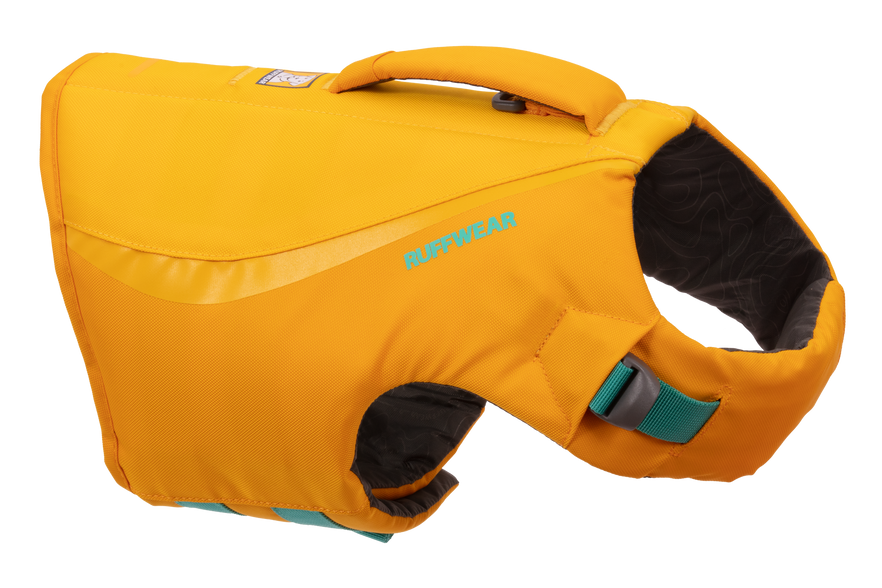
$99.99
Best suited for
- Boating and paddleboarding
- Swimming and water play
- Waterfowl hunting
- Dock diving
Poor fit for
No major disqualifiers noted in our research.
Pros
- Strategically placed closed-cell PVC-free foam panels for flotation
- Reinforced rescue/lift handle with integrated leash attachment ring
- Telescoping neck closure for an adjustable, secure fit
- Reflective trim for low-light visibility
- Integrated light loop for attaching a Ruffwear Beacon visibility light
- Sheltered, easy-to-clip buckles
- Available in six sizes (XXS–XL) fitting a 13–42 in girth range
Cons
- Size-dependent design requires selecting one of six sizes and measuring girth
- Between sizes Ruffwear recommends sizing up for a relaxed fit or down for a snug fit (selection required)
This page is a research rundown of Ruffwear’s own documentation for the Float Coat, not a hands-on test. Everything below traces to Ruffwear’s product materials.
How the flotation is built
The foam is closed-cell and PVC-free, and Ruffwear places it in panels rather than as a uniform layer, with a full-length belly panel wrapping the chest and belly. The shell is a durable fabric over nylon webbing, and the buckles are described as sheltered and easy to clip.
Sizing: measure the girth, then follow one rule
The Float Coat comes in six sizes, XXS through XL, covering a 13–42 inch girth range measured at the widest point of the chest. Ruffwear does not publish per-size girth breaks on the materials we reviewed, so the chest measurement is the gate: measure first, then read the company’s size chart.
Between sizes, Ruffwear’s rule is specific: size up for a relaxed fit, down for a snug one. On a flotation garment that rule matters more than usual — the belly panel and neck closure only do their job against the body.
The safety hardware
- Reinforced rescue/lift handle, with an integrated leash attachment ring
- Telescoping neck closure for adjustability at the collar
- Reflective trim, plus a light loop sized for Ruffwear’s Beacon light
- Sheltered buckles
Ruffwear lists the intended uses as boating and paddleboarding, swimming and water play, waterfowl hunting, and dock diving, and backs the jacket with a limited warranty against defects in materials and workmanship. If you want a second research perspective, the Outward Hound Granby covers the budget head-support angle, and the EzyDog DFD covers the widest size run.
Safety considerations
- Handle is reinforced for rescue or lifting and includes an integrated leash attachment ring
- Telescoping neck closure provides an adjustable, secure fit
- Reflective trim improves low-light visibility
- Integrated light loop accommodates a Ruffwear Beacon visibility light
- Sheltered buckles are designed to be easy to clip
Verified specifications
- Ruffwear
- Float Coat
- Size-dependent; wraps over the chest and belly with a full-length belly panel for in-water support
- Closed-cell PVC-free foam panels, Durable shell fabric, Nylon webbing straps
- XXS, XS, S, M, L, XL
Sizing & compatibility
Fit depends on your dog's measurements. Measure girth (the widest part of the ribcage) and consult the manufacturer's size chart before buying — a poor fit can cause chafing or let an escape-prone dog back out of the harness.